Compete
Register Prize Purse Official Rules Officials & Judges Hall of Founders Kite Specifications Tournament Format Safety Standards Sportsmanship
04
Rules & format

One sky, two lines, four minutes.

Blades stay in the main bracket. Everything around them is procedure: sealed hardware, measured lanes, two-marshal confirmation, and a whistle that stops the whole field at once.

Read the rulebook Safety & waivers
01
Register and pick a class
Individual, crew of three, or both classes at once. Buy the Haitian-styled kite with entry, or bring your own single-line kite.
02
Fit and inspect
Frames, lines and blades are checked and sealed at the tech tent. Unsealed hardware does not reach the field.
03
Fly the heat
Four-minute heats, two to four kites per sky. Cut a line and you advance; touch the ground and you are out.
04
Recover and score
Runners bring down the cut kites, marshals confirm the cut, and the ladder updates before the next bell.
Entry classes

Enter as one, or enter as a crew

The founding edition runs two classes. Individuals fly their own bracket to a single champion. Teams of three share a lane block and a clock: cuts by any member count to the crew, and a team survives while one kite stays up. Any competitor may enter both classes — the same kite flies both draws, they are scheduled so they never clash, and both purses are open to you.

Entry classCompetitorsLanesBracket
Individual 1 1 Double elimination to a final of four
Team of three 3 3 Crew survives while one kite flies
Both classes 1 1 + 3 Register for both; draws never clash
The rulebook in brief
Kite
Single-line only. Haitian-styled frame recommended; maximum span 90 cm, maximum tail 2 m.
Line
Championship-issued line only. No abrasive or glass-coated line of any kind.
Blade
One sealed blade per kite, issued at the line and returned after the heat.
Heat
Four minutes. Two to four kites per sky, one competitor per lane.
A cut
The other line parts while your kite stays airborne. Confirmed by two marshals.
Out
Your line parts, your kite touches ground, or you cross into another lane.
Recovery
Trained runners only in open classes. Youth lanes: the finder keeps the kite.
Stop
A single marshal whistle grounds every lane immediately. No exceptions.
Full rulebook, draft v0.4
Safety & waivers

A bladed sport, run like one

Blades are supplied, sealed and fitted by marshals at the line — never brought in, never carried off the field. Everything else is procedure, and procedure is not optional.
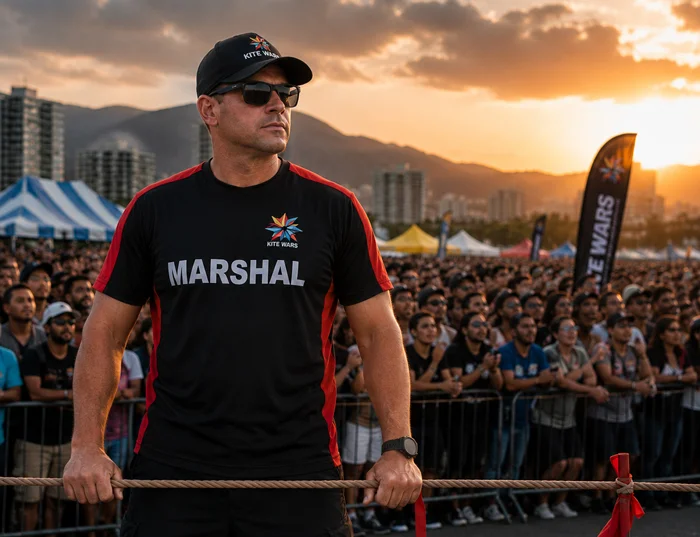
Blades supplied, fitted and collected by certified marshals — never brought, never taken home.
Spectators behind a fixed rope line, upwind of every lane and outside the drop zone.
Trained recovery runners only; no public chasing outside designated youth lanes.
Helmet, gloves and eye protection issued with every entry and mandatory on the field.
Signed waiver, medical form and a safety briefing before any competitor reaches the line.
Medics on field, a wind ceiling enforced, and a single marshal whistle stops all lanes.
Never permitted, anywhere, at any time
Abrasive, glass-coated or metal-cored line (cerol, manja) — instant disqualification.
Bringing your own blade onto the field, or removing an issued one.
Dual-line and quad-line kites in any class.
Chasing a fallen kite outside a designated youth lane.
Certified kite specifications

What makes a kite legal

Every kite passes the tech tent before it reaches a lane. The Official Kite Package is certified by definition; a kite you build or bring must meet the same numbers. Certification is free and takes about five minutes per kite.

SpecificationRequirement
Line configuration Single line only
Maximum span 90 cm tip to tip
Minimum span 45 cm tip to tip
Shape Haitian hexagonal recommended; any single-line shape within span
Maximum tail length 2 m from the tail bridle
Frame Wood, bamboo, palm rib or fibreglass spars — no metal
Cover Paper, tissue, ripstop or mylar; artwork unrestricted
Bridle Three-point Haitian bridle or equivalent; must hold under load
Flying line Championship-issued only — collected at the tent, returned after your last heat
Blade Championship-issued and marshal-fitted only. Never brought, never removed
Maximum weight 220 g rigged, without line
Identification Registered competitor number visible on the cover face
Certification
Certified kites carry a sealed tag
Bring the kite to the tech tent on your arrival day, or any morning before your heat.
An inspector measures span, tail, weight and bridle, and checks the frame for metal.
A numbered seal is fitted to the spine. Break the seal and it must be re-certified.
Certification is free, takes about five minutes, and covers a spare kite as well.
Not certifiable
Dual-line and quad-line kites of any size.
Abrasive, glass-coated or metal-cored line (cerol, manja).
Metal spars, weighted tips, or any hard object in the tail besides the issued blade.
Kites carrying advertising that conflicts with a sponsor's category exclusivity.
Code of Sportsmanship

Cut the line, not the person

Every registered competitor, crew captain, official and volunteer signs this. It is short on purpose, and the Head Judge can act on any clause on the day.

01
Fly the kite, not the competitor
Contact with another person, their line at the ground, or their equipment off the field is never part of the sport.
02
Accept the call
Marshals are final in the moment. Disagree in writing within thirty minutes; never on the lane.
03
Return what is not yours
Cut kites go to recovery marshals in open classes. Keeping another competitor's kite is theft, not tradition.
04
Respect the country
You are a guest of the host city. Its laws, its customs and its people come before the bracket.
05
Help a beginner
Half the field will be first-timers. Lend a spar, show a knot, and the sport survives another generation.
06
No blade off the field
Carrying an issued blade past the lane perimeter ends your championship immediately. No appeal.
Breaches are handled by the Head Judge: a warning, a forfeited heat, or removal from the championship and the world ladder. Serious breaches are reported to the competitor's national federation.
World ladder

Cuts are counted. Names carry.

Every sanctioned heat feeds a world ladder: cuts landed, cuts survived, kites recovered, time held. Qualifiers through 2026–27 seed the championship draw, and your ladder position lives on your Timl profile between editions.

·One point per confirmed cut; two for a cut in a final.
·Time held counts as a tiebreak, measured in whole seconds.
·Team points accrue to the crew and to each registered competitor.
·Sanctioned qualifiers carry full ladder weight; exhibitions carry none.
#CompetitorCountryCutsHeld
1 Open qualifier seat
2 Open qualifier seat
3 Open qualifier seat
4 Open qualifier seat
5 Open qualifier seat
6 Open qualifier seat
7 Open qualifier seat
8 Open qualifier seat
Ladder seats open with the qualifier calendar. Seeds are published eight weeks before the first bell.

Federations: mark up the draft

A format nobody outside has reviewed is not a sport. Send amendments to rules@kitewars.com and they are logged into the next draft.

Partnership options Register